Fair Water Texas kids you not: A protester complaining about bad municipal water was arrested in Trinidad Tx for a Facebook post about bad water harming residents. The fallout has been the focus, but the real problem is the water.
For weeks, the public has watched Trinidad, Texas unravel in real time: arrests over Facebook posts, a municipal judge fired mid‑term, city employees terminated, a police chief resigning, and a city council hiring a replacement whose job-hopping might be indicative of a sketchy record. News outlets have covered the spectacle, but they’ve missed the most important part of the story.
The real issue is the water — and what the city is trying to build despite it.
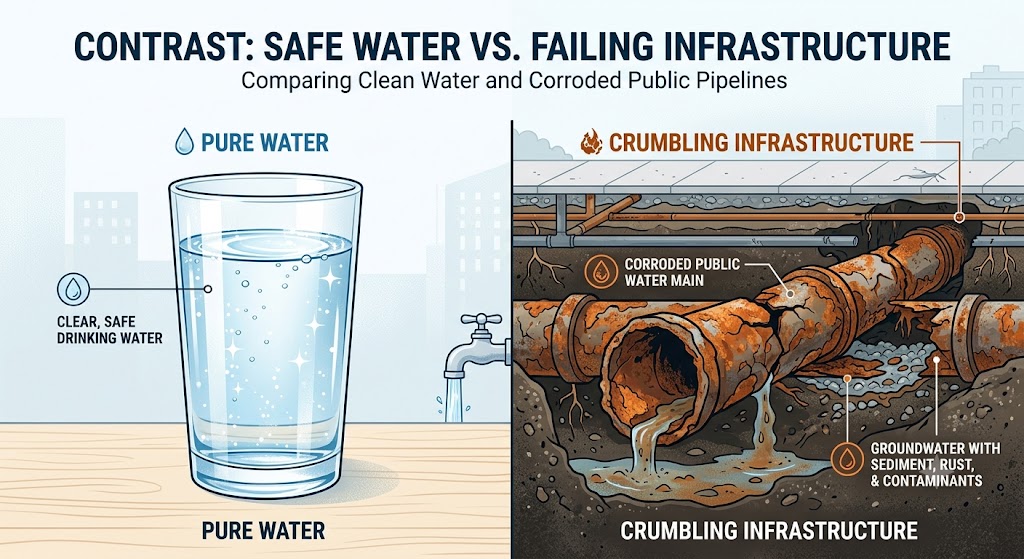
Across the transcripts and reports, residents continue sending photos of brown, discolored water. A citizen journalist was arrested after posting that people were being hospitalized. A peaceful protester was arrested for holding a sign criticizing “bad cops.” A municipal judge was fired after dismissing that protester’s case. But buried deep in the coverage — mentioned only once — is the real driver behind the chaos:
“Not only are they having water issues… they’re trying to bring data centers to the city of Trinidad.” (See agenda item 17 here.
That single sentence explains everything.
A Town in Crisis — But Not for the Reasons You’re Being Told
A pattern is emerging:
- Residents raise concerns about water quality.
- Instead of addressing the water, officials target the critics.
- A municipal judge is fired after dismissing a weak case.
- The city attorney is fired for giving correct legal advice.
- The police chief resigns — and the officer involved in the controversial warrants is promoted.
All while the water remains discolored. All while residents demand answers. All while lawsuits pile up.
And in the background, the city is quietly advancing a data center project — a project that requires massive, continuous water supply.
The Real Warning for Rural Texas
Fair Water Texas believes every rural community deserves to see this warning clearly:
What happened in Trinidad is not an accident — it is a blueprint.
When a small town with a limited, aging water system is suddenly asked to support industrial‑scale water demand, the pressure doesn’t just strain pipes. It strains politics, policing, and public trust.
Trinidad shows exactly how it unfolds:
- Residents report brown or unsafe water.
Instead of transparency, they face arrests and retaliation. - Local officials shift their focus away from fixing the water system.
Judges, clerks, and attorneys are removed when they don’t support the narrative. - A major industrial project quietly advances.
In Trinidad’s case, a data center — barely mentioned publicly, but central to the city’s priorities.
This is the pattern rural Texas must recognize:
When development becomes the priority, water becomes the casualty.
Data centers, crypto mines, and other high‑load industrial users require:
- continuous, high‑volume water
- cooling capacity far beyond residential needs
- infrastructure upgrades small towns cannot afford
- political decisions that often override public health concerns
And when residents push back, the response can look like Trinidad:
- criminal charges for speech
- firings without cause
- legal chaos
- secrecy
- and a government more interested in protecting a project than protecting its people
Is this the canary in the coal mine?
Fair Water Texas believes rural communities must understand what Trinidad reveals:
If your town’s water system is already strained, industrial development will not strengthen it.
It will expose it — and the political fallout can be severe.
More rural towns will face this same crossroads and will be pressured to approve projects they cannot support. More will see water quality decline while officials insist everything is fine. More will learn that once industrial demand arrives, residents’ concerns become inconvenient.
Trinidad is among the first to break into public view. It will not be the last.
Fair Water Texas will continue monitoring Trinidad — and every Texas community where water, power, and development collide.